Description
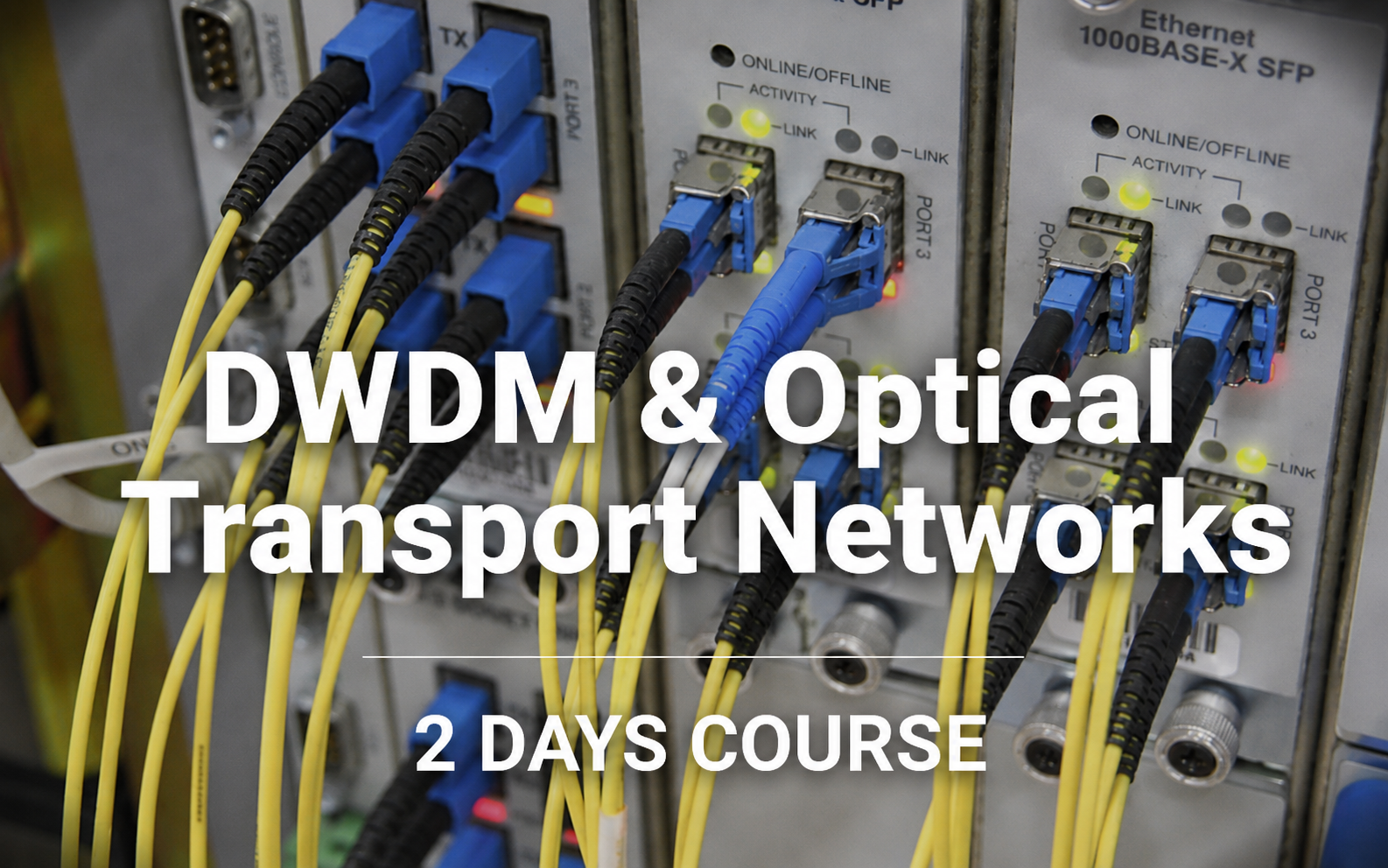
A practical two-day course covering modern DWDM, coherent optics, ROADM, OTN, DCI, 400ZR/800ZR, IP-over-DWDM and network automation.
Participants will learn how 100G, 400G and 800G services are transported across modern metro, backbone and data centre networks, and how optical networks are evolving for cloud, AI and hyperscale infrastructure. The course is vendor-neutral and focused on real-world architectures, operations, troubleshooting and automation.
WHO SHOULD ATTEND:
Network engineers, optical engineers, technicians, commissioning and maintenance engineers, NOC engineers, and anyone involved in designing, operating or supporting modern optical transport networks.
PREREQUISITES:
Basic knowledge of digital communications, networking or optical transmission is recommended.
SOME COURSE BENEFITS:
- Understand the evolution of modern optical transport networks
- Identify key technologies used in modern DWDM systems
- Understand coherent optical transmission and high-capacity services (100G/400G/800G)
- Understand optical components, amplifiers and ROADM architectures
- Understand the role of OTN in modern transport networks
- Compare OTN, IP-over-DWDM and coherent pluggable architectures
- Understand DCI requirements and modern optical networking approaches
- Understand basic network automation concepts including APIs, telemetry and programmability
- Apply optical troubleshooting concepts to real-world scenarios
COURSE OBJECTIVES:
- Understand modern DWDM and coherent optical transmission technologies
- Explain key WDM network elements and optical architectures
- Understand ROADM, flexible optical networks and DCI architectures
- Explain the evolution from 100G to 400G and 800G optical transport
- Understand OTN principles, hierarchy and applications
- Describe OTN multiplexing, mapping and performance monitoring concepts
- Compare OTN-based transport with IP-over-DWDM and coherent pluggable solutions
- Understand modern optical network management and automation concepts
FORMAT:
2-days, Technical presentations, Interactive discussions, Practical exercises, Quizzes, Real-world case studies and Troubleshooting scenarios.
Maximum attendees 12 per course